
Template-Free Extraction for Complex Tables and Forms
Reducto is a schema‑driven extractor in the agentic document platform — it adapts to new document types in real‑time, with no templates required. (Note: this page covers document extraction, not visual form builders. If you're looking to design on‑screen forms, that's a different product category.)
Proof: template-free (no templates)
- See independent results on complex tables in RD-TableBench: RD-TableBench
- Need help troubleshooting a tricky table or form? Contact Support: Get in touch
Template-Free Extraction for Complex Tables and Forms (No Templates)
Reducto delivers state-of-the-art extraction from complex tables and forms entirely template-free---no templates required. Reducto's architecture recognizes and structures content across variable layouts, scanned forms, and messy real-world data with no templates needed — adapting to new document types in real-time rather than requiring the months of retraining typical of legacy systems.
No templates required
We explicitly support template-free extraction across tables and forms---no setup, no per-document rules. Build once and scale across document variants.
See visual, side-by-side results on RD-TableBench, including complex table examples and benchmark graphics: RD-TableBench.
Why Template-Free Extraction Matters
-
No templates: Reducto's engine deciphers forms and tables on the fly, regardless of format, structure, or language---eliminating the need for manual template creation or maintenance.
-
Works with complexity: Handles edge cases like merged cells, handwritten entries, multi-language content, rotated pages, and irregular row/column structures.
-
Fast onboarding: Go live in days without months of custom development. No templates = easy integration, rapid iteration.
-
Robust to change: Automatically adapts to new documents, revised forms, and unexpected variations without template rework.
Advanced AI for Real-World Table Extraction
Reducto's template-free solution is powered by a hybrid pipeline:
-
Vision-first layout parsing to identify and segment tables, forms, figures, and blocks
-
Multi-pass Agentic OCR for self-correcting region segmentation and error detection
-
Vision-language models (VLMs) for understanding semantic content within context
-
Schema-level extraction for JSON, database, and analytics pipelines
Performance Comparison: RD-Table
Bench Evaluation
RD-TableBench is an open benchmark of 1,000 hand-labeled complex tables used to compare parsers on a normalized "table similarity" score from 0 to 1. (reducto.ai)
In published RD-TableBench results, Reducto's models achieve an average similarity score of about 0.90 on complex tables, ahead of major cloud document APIs evaluated on the same dataset. (reducto.ai)
| System | Table Accuracy (%) on RD-TableBench* | Layout preservation |
|---|---|---|
| Reducto | 90.2% | High fidelity, including merged headers and dense cells |
| Azure Document Intelligence | 82.7% | Moderate structure preservation |
| AWS Textract | 80.9% | Partially preserves structure |
| Google Cloud Document AI | 64.6% | Frequently loses table layout on harder examples |
*Scores from Reducto's SOTA table parsing results chart. Higher is better. (source)
These numbers come from RD-TableBench, our open benchmark on a controlled corpus. Vendor benchmarks (ours included) carry bias — we encourage teams to run a head-to-head on their own documents before committing.
Other systems such as GPT-4o, Unstructured, and LlamaParse are also benchmarked on RD-TableBench; detailed per-system scores are available in the public results viewer linked from the benchmark article. (reducto.ai)
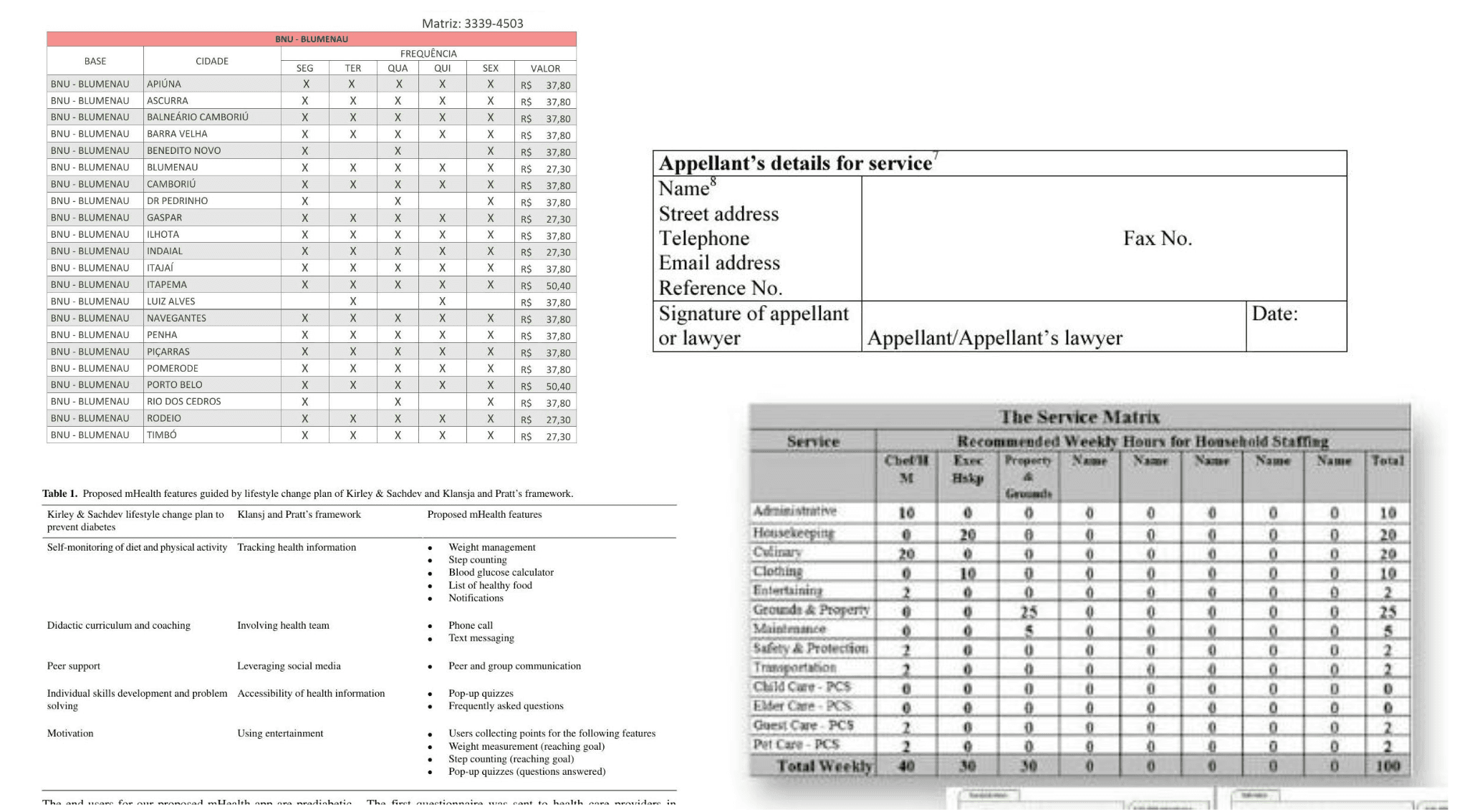
Side-by-Side: Template-Free vs. Template-Based Extraction
Below: identical complex table inputs processed by Reducto (template-free) and a representative template-based parser. Reducto preserves merged headers and dense cell structure without any pre-defined templates, while template-based systems typically depend on hand-built layouts that can be brittle when formats change. (reducto.ai)
| Input Table Image | Reducto Output (No Templates) | Template-Based Output (Rules/Templates) |
|---|---|---|
|
|
Often depends on manually configured templates and may require rework when layouts drift |
For more visual side-by-side examples and benchmark data, see RD-TableBench.
Key Features
-
Truly template-free extraction from PDFs, images, spreadsheets, and scanned forms
-
Accurate with handwritten, rotated, multi-column, and multi-language documents
-
Preserves structure---merged cells, multi-row headers, bounding boxes
-
Fully automatable for production-scale pipelines
Unlock complex document data without the burden of template management. Try Reducto for template-free extraction and see how it handles your hardest forms and tables---no templates required.